Why AI scoring still leaves your managers digging through calls (and what to do about it)
Perhaps you bought conversation intelligence software so that your managers could stop listening to so many calls and focus instead on coaching. Let’s assume your implementation went well (it doesn’t always) and every single call gets automatically reviewed and scored.
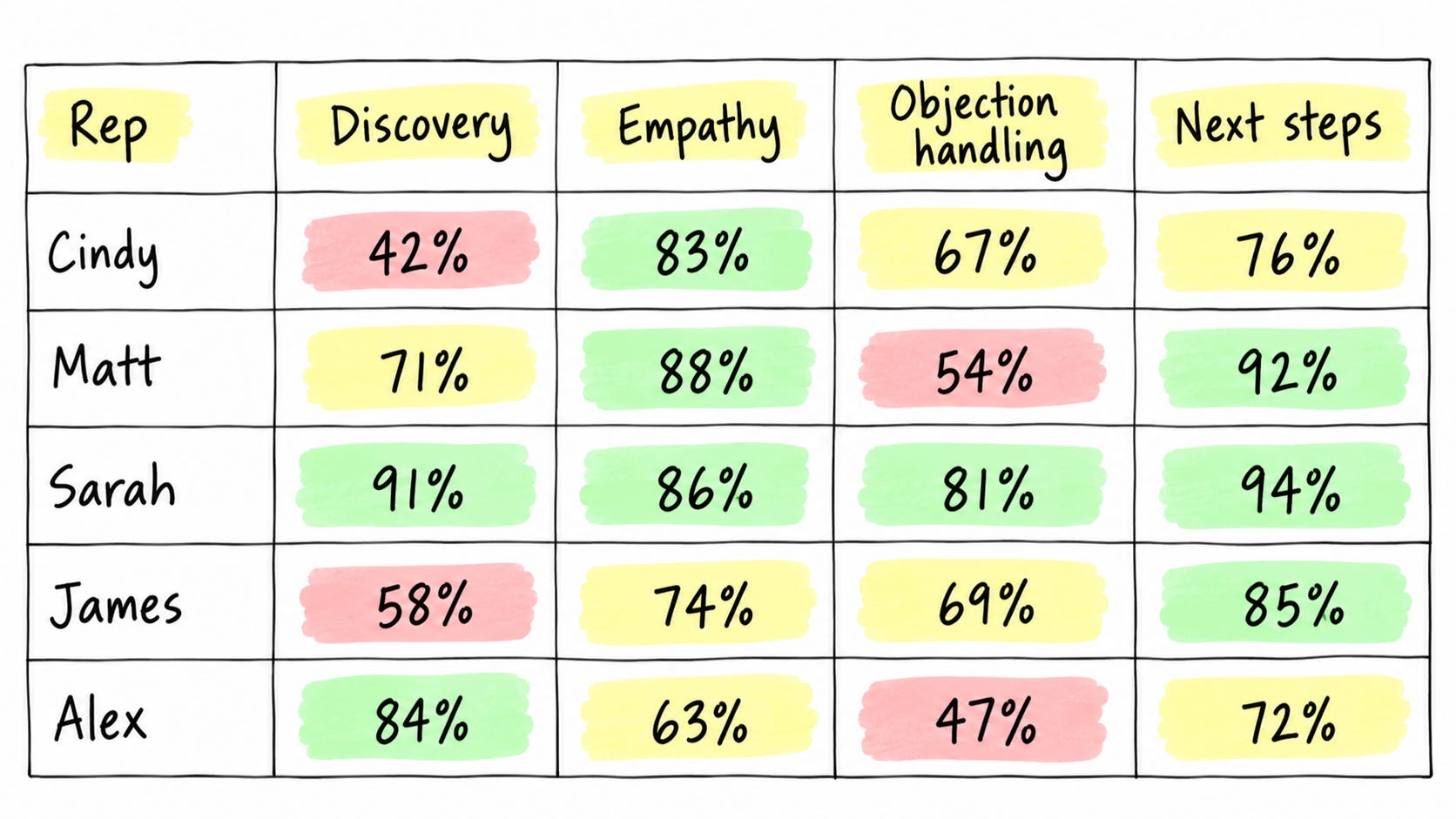
You get this amazing dashboard.
Cindy is at 42% on discovery. So that’s why her enrollments are down. Mystery solved!
But wait...why is her discovery at 42%? Well, shoot. The dashboard doesn’t tell me that.
Managers know they can’t simply walk into a 1:1 and say,
“You’re at 42%. Increase discovery.”
Cindy would walk out wondering what, exactly, she’s supposed to do to increase discovery.
Instead, your manager is going to want to do some prep work to figure out why her discovery is so low. Which means they’re going to do something quite familiar:
Dig into calls.
Interesting. Isn’t digging through calls the exact thing you bought the AI to stop doing?
Scores don’t diagnose
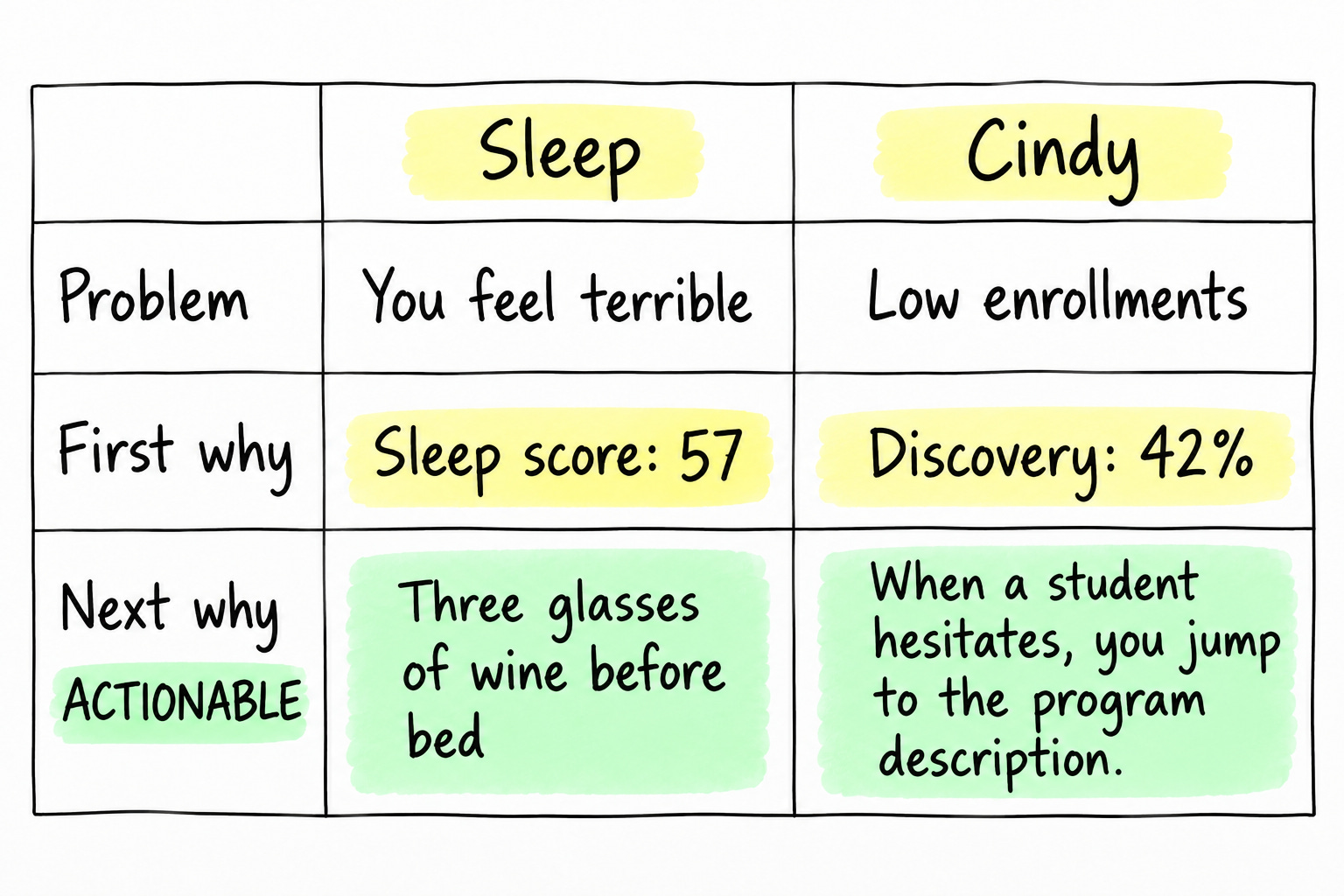
Scoring gets you one “why” deep. Cindy is struggling with enrollments, and it points you toward discovery. But to coach Cindy, you have to go at least 2 why’s deep: why is she struggling with discovery?
A good manager approaches this much like a doctor. Is Cindy skipping discovery altogether? Does she ask questions but give up when students hesitate? Or maybe she’s asking all the right questions, but never goes that level deeper.
So a good manager listens across calls, looks for a pattern, and decides what to work on first.
Eventually, they have something actionable to give Cindy, like: “When a student hesitates to answer, you jump straight to the program description, and they go quiet. Next time, ask what’s making them hesitate, and they might just open up.” (this follows the structure laid out here).
Now Cindy has something she can try on her very next call.
Scoring more calls is of course a valuable part of this process. It gives the manager a place to start digging to fix Cindy’s enrollment performance. But there’s still a lot of work between seeing a score and knowing what to coach.
It’s a lot like a sleep score. You wake up feeling terrible. Your watch says 57. OK, now you know why you feel terrible: you slept badly.
But “sleep better” isn’t something you can do tonight. You need to know why you’re sleeping badly.
Now imagine your Apple Watch said: “Dude, stop drinking three glasses of wine before bed.”
Some of you would keep drinking three glasses. (No judgment.) But many of you would cut back. You have something specific to change and a way to see whether it helped.
That’s the diagnosis your best managers are trying to make when they prepare for coaching. Getting there takes quite a bit of work.
Introducing Coaching Priorities in Voiceops
This week we’re launching Coaching Priorities. It uses the scores as a starting point, then does the call research and diagnosis your managers do to figure out what specifically to coach.
For Cindy, 42% on discovery tells us where to dig. Voiceops then looks across her discovery conversations and finds a recurring pattern: when a student hesitates, she moves straight to the program description. It checks how often this happens and what happens next in those conversations.
Then it looks at how other advisors handle that same moment. Who gets the hesitant student talking again? What do they say?
It weighs that problem against the other things Cindy could work on, taking into account how often each happens and how much it appears to hurt the conversation.
You get a few specific changes to focus on, with the calls behind each one so you can check the reasoning yourself.
Then you and Cindy can listen to those moments together, practice what to ask the next time a student hesitates, and watch her scores and performance rise.
Performance → Scores → Coaching Priorities is the complete picture you need for a great 1:1.
See how Voiceops fits your admissions and enrollment team.
Book a demo
Continue reading
Article
The 5 most interesting ways higher ed is deploying AI today
From proactive student outreach to reviving cold leads, here are five high-impact ways career and trade schools are using AI today, straight from the CECU exec conference.
Read the article↗
Article
Your Scorecard Is More Complicated Than You Think
Most AI scorecards stall because each item hides a pile of unwritten exceptions and manager disagreements. Here’s how to surface those rules and finally get scores your team trusts.