If you want to make a QA leader wince, ask how their AI scorecard is going.
A lot of them will tell you it’s still not working. They were told it would take a few weeks. It’s been a year, and they’re still “tweaking” it.
And that’s expensive. The whole point was to see what’s really happening on every call, free up your managers to coach, and move performance. A year of tweaking means none of that happens.
I hear this story all the time on sales calls, and the reason is almost always the same:
their scorecard is more complicated than they thought.
For example: here’s an item you’ll find on almost every call scorecard:
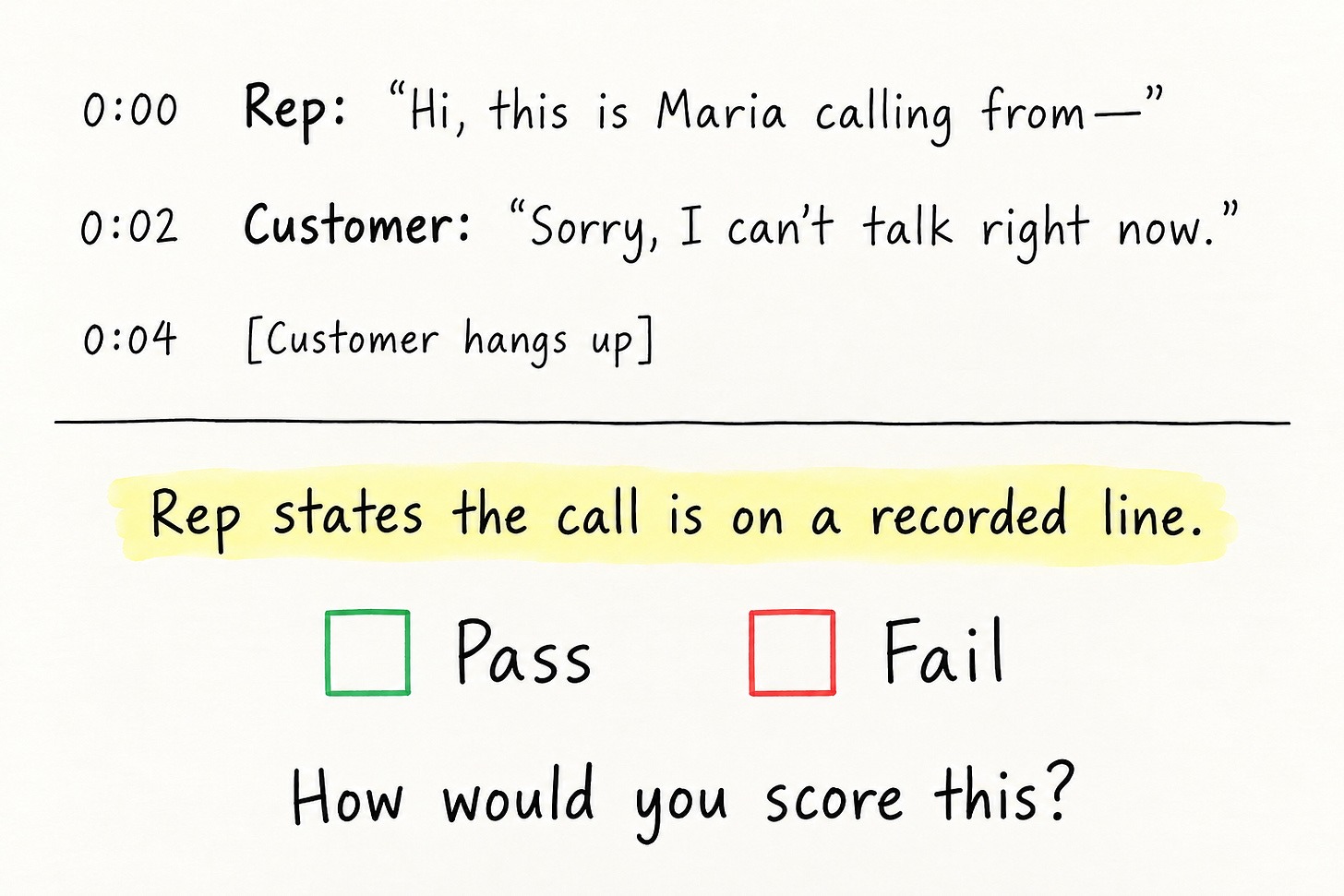
Rep states the call is on a recorded line.
This is as simple as scoring gets, right? Either the rep says it…or they don’t.
Well, I’m sorry to say. Even this one is more complicated than you think.
What if the customer was talking over the rep during the recording disclosure and didn’t hear it? Does the rep get credit?
What if the rep didn’t state the disclosure until two minutes in, because the customer started venting the moment they picked up and there was no polite way to interrupt?
What if the customer hung up after ten seconds and the rep never had a chance?
All the time, your QA team and managers are making judgements like these when they review calls. They have probably built some pretty good intuition around it.
But none of this is written down. Which is the crux of why projects to automate a scorecard often stall.
AI is really good at following instructions, but can’t read your mind. At least not yet (hello, 2030s)
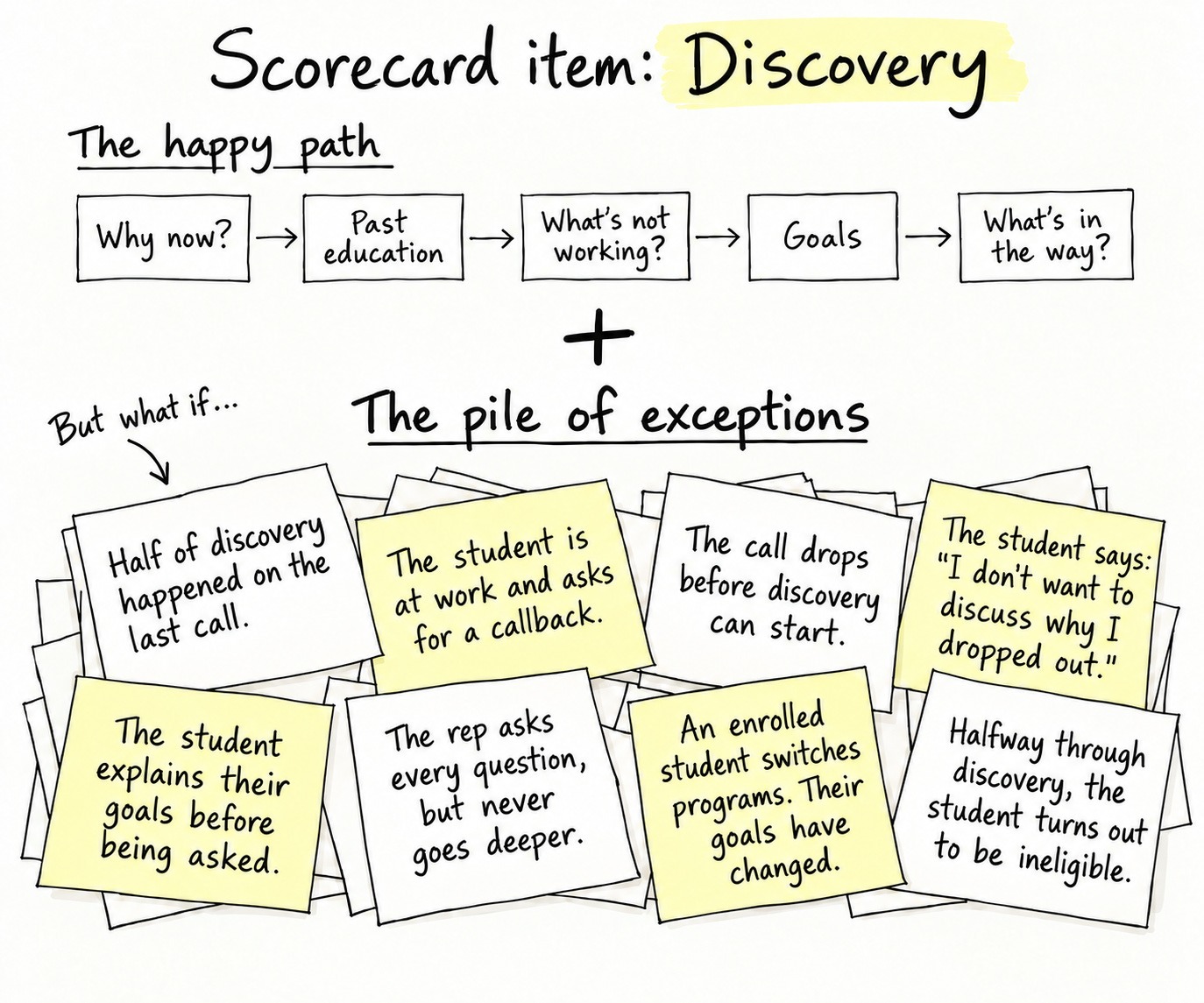
Most people only write down the rules when things go the normal way (the “happy path”). But each scorecard item is really a “happy path” plus a big ol’ pile of exceptions, and the exceptions rarely get written down.
You’ll never break 70% accuracy of an AI scoring your scorecard if you don’t write down all the exceptions.
Implementation purgatory…and how to get out
Here’s something that might shock you. When we capture every rule a team actually uses for a single scorecard item (I mean all the guidelines, exceptions, and judgments that live in people’s heads), the instructions average about eight pages, single spaced.
Not for the scorecard. For one item in the scorecard.
So rough math: 10 items on your scorecard; 80 pages of single-spaced instructions for the AI. (of course, we have ways of making it easy to generate these rules so nobody is actually writing 80 pages of instructions by hand)
Most teams never get anywhere close to that level of detail. They write a paragraph or two of instructions per item, launch, and then spend months discovering the missing exceptions one wrong score at a time.
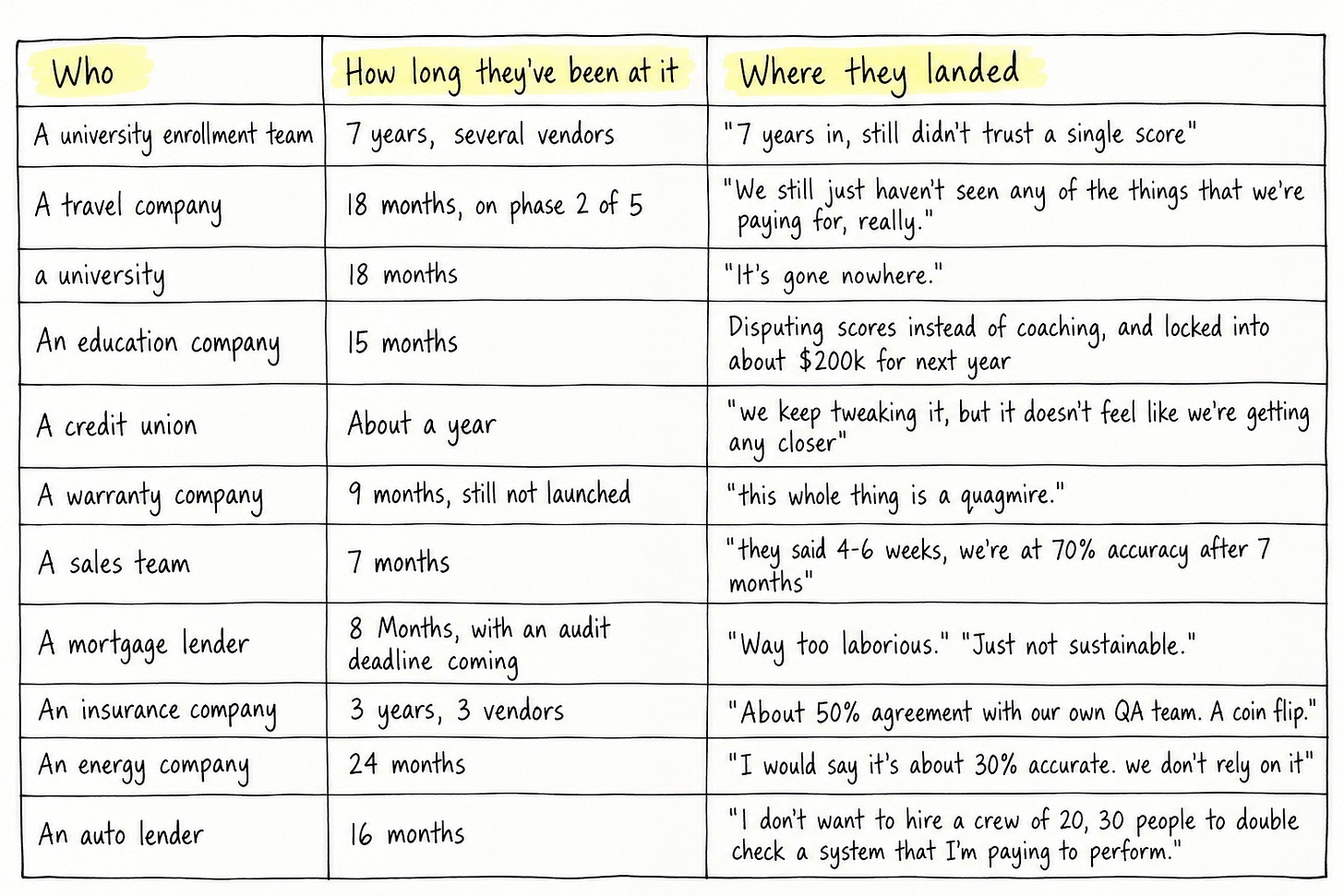
About half our customers come to us after having spent a year or more trying to implement another tool. We call this implementation purgatory: a year of tweaking, and scores the team doesn’t trust.
This is a real shame because it’s quite consequential:
You lost a year of meaningful performance improvement from having good data.
You burned a bunch of trust with your reps with low-accuracy AI.
You burned out your managers, who had yet another job to do implementing AI.
It’s actually sometimes worse than that. Perhaps the reps started appealing scores, and so you started a whole time- (and soul-) sucking process of adjudicating every wrong score. Or maybe the reps figured out the exact phrases that earn credit and started using them on every call, ironically making the calls more stilted and overall worse. Your software actually had negative ROI!
(By the way, I’ve cataloged all the companies we’ve spoken with that found themselves in implementation purgatories...there are more than 200. A few recent ones are in the chart at the bottom.)
If you are in such a purgatory, you may be questioning whether AI can work in your complex environment.
It can, and the way out is straightforward. You just need to cover 2 kinds of issues the AI instructions face:
1. Rules your managers disagree on
Picture a calibration session at an online university. Three enrollment managers listen to the same call. The scorecard says advisors should cover the program before talking about cost. But this student asked about tuition in the first minute, and the advisor answered right away, then went back to the program.
One manager docks the advisor: build value before price, every time. Another gives full credit: you were helpful by answering the student’s question. A third says it depends on whether the advisor quickly pivoted back to why the program fits this student. Three managers, three opinions.
It is guaranteed your internal folks don’t agree on everything. If you do weekly or monthly calibration sessions between managers, you already know this. Yet humans can disagree like this and the team still works. Sure it’s not perfect....everyone scores slightly differently based on their preferences, but for the most part it works just fine.
An AI, however, can only give one answer. Tune it to one manager, and the others think it’s wrong. Tune it to theirs, and now the first manager thinks it’s wrong.
The fix: before you build anything, get the people who score and coach calls in a room and go through the scorecard item by item, using real calls. Every time someone says “it depends,” you’ve found a rule. Argue it out, pick an answer, and write it down. The AI’s consistency is a strength, but only once you’ve agreed on what it should be consistent about.
2. Rules nobody has written down (the “pile of exceptions”)
These are the exceptions to the happy path. Some are so obvious to your team that nobody thinks to say them out loud. Others nobody would think of until they hear the actual call.
Picture an advisor who doesn’t start the application with the student on the phone, which is a required step. Your managers would never ding them for it if, for example, the application system was down. And yet nobody wrote that down, because why would you? It’s obvious.
The AI dings them anyway. Why?
It wasn’t in the instructions.
Every scorecard has hundreds of these. Here are a few silly examples that will seem completely obvious to you — but not to the AI:
A student who called inbound doesn’t need to be asked if they have a few minutes to talk.
A scheduled follow-up doesn’t need to repeat the discovery from the first call.
If the student disqualifies themself on question 2, no need to ask the remaining qualification questions.
The prospect is upset. It would be quite awkward to ask for a referral.
You can’t brainstorm your way to all of them, because nobody remembers they exist. You have to go find them in actual calls, in two passes.
First pass: let the AI find them. As with many AI problems, AI is also the cure. Run your scorecard across thousands of calls and have the AI flag every call where it thinks there may be an exception. We call this “exception detection,” and AI is actually pretty good at it. You can then address those exceptions in the instructions.
Second pass: let your reps find the rest. You won’t catch everything before launch, and waiting until you do is how teams spend six months “almost there.” So, launch, and give your reps one goal to hit: e.g. if the team’s average quality score is 53% today, aim for 70%. Make it a competition, and ask reps to flag any score they think is wrong. Make it fun and positive. Every time your rep flags a score they disagree with, it helps you identify rules you may have missed, found by the people who are closest to the calls.
Just don’t tie the scores to pay...at least not yet. If you do, you’ll end up in a world of litigating scores. To address it, you’ll then find yourself creating a process for reps to appeal scores. And now everyone’s got more work to do. Keep it about getting better, and your reps will help you finish the implementation.
throwing in the towel?…wait!
If you’re stuck right now in implementation purgatory, you didn’t do anything wrong. Your scorecard was just more complicated than you were told.
Once the rules are written down, AI scoring your calls works, and faster than most people expect. The SVP of Operations at one of our clients told us: “I spent seven years trying to get confident with this capability. ... We were ready to throw in the towel. ... And in less than a quarter, we got confident.”
It’s all about the implementation process. AI really can feel like magic in the end, but it is best not to treat it as such during implementation.
Here’s where to start. Get your managers in a room, play a call, and score it together. The disagreements will come fast. Talk each one through, pick an answer, and write it down. Then play the next call.
A sample of our compendium of more than 200 examples of implementation purgatory:
See how Voiceops fits your admissions and enrollment team.
Book a demo
Continue reading
Article
The 5 most interesting ways higher ed is deploying AI today
From proactive student outreach to reviving cold leads, here are five high-impact ways career and trade schools are using AI today, straight from the CECU exec conference.
Read the article↗
Article
You can’t coach a score
A low AI score tells managers where to look, not what to coach. Here’s why scores fall short and how Voiceops Coaching Priorities finds the specific fix.